AI & Data
A seat for everyone, or a system that does the work
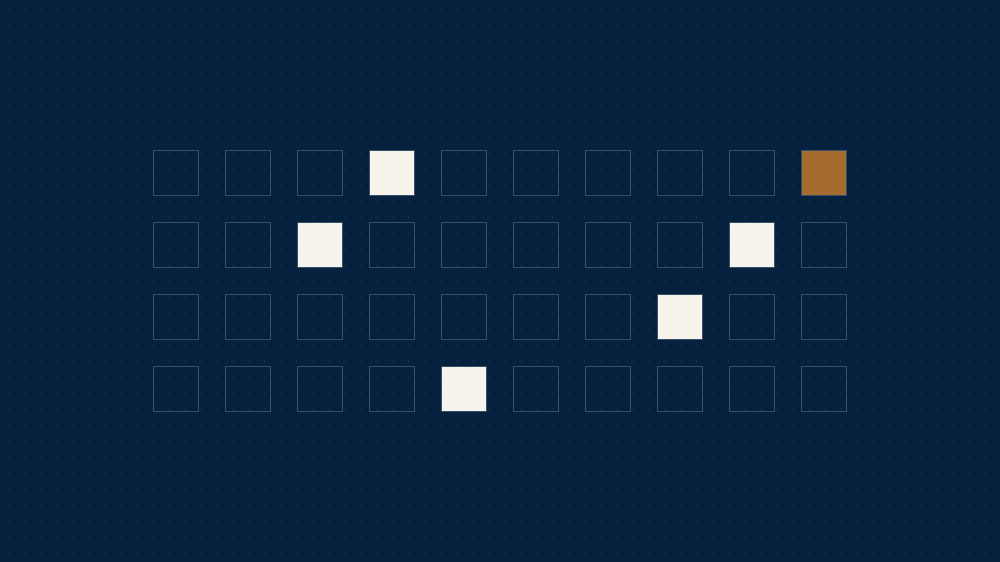
There are two ways to pay for AI, and most organisations have only tried one of them. The first is to buy a seat for everybody and see what happens. The second is to take one piece of recurring work, build the thing that does it, and pay for what that consumes. They cost very different amounts. More usefully, only one of them produces a number you can defend at the end of the year.
Both can be the right call, but they answer different questions, and comparing them on licence cost alone is how the wrong one gets bought. Before buying seats for everybody, it is worth asking the simpler version: do you want to give somebody a better tool, or do you want the task itself to take less work?
What a seat is priced for
A per-seat subscription is priced against its heaviest plausible user. It has to be. The vendor cannot know in advance whether you are the person who lives in it all day or the person who opens it twice a quarter, so the price has to cover the first. Buying one for everybody means paying the heavy-user rate across the whole payroll.
Usage does not spread out to match. It is almost always skewed: a few people use the tool constantly, a slightly larger group use it in bursts, and the rest tried it in the first fortnight and have not been back. Nobody is doing anything wrong; that is simply how optional tools get adopted. But it means the spending is flat while the value is concentrated, and the gap between those two shapes is where the money goes.
What a task costs
Now take a single piece of work that happens over and over. Turning a set of documents into a standard brief. Pulling the fields out of an inbound enquiry and putting them where they belong. Drafting the first version of a reply that a person then checks and sends.
The useful number is not the licence fee. It is what getting that task done costs today: how often it happens, how long it takes, how many people touch it, and how much checking and rework it carries. That figure is harder to find than a price list, and it is the only thing either option can honestly be compared against.
Priced as a task rather than as a person, the arithmetic changes shape entirely. The cost becomes a unit cost multiplied by how often the work happens, and a defined task consumes a bounded amount, so you know roughly what goes in and what comes back. It stops being a function of headcount. Hiring twenty more people does not change it.
A worked example
Every figure below is an assumption. Substitute your own; it is the shape that matters, not the numbers.
Take a firm of forty people, and suppose a premium seat costs two hundred dollars a month. Forty seats for twelve months is ninety-six thousand dollars a year, and it is the same ninety-six thousand whether the tool is opened daily or not at all.
Now suppose one of those recurring tasks runs four hundred times a month, and each run costs under ten cents in model usage. That is somewhere around four hundred dollars a year.
The honest part of the comparison is the build. The workflow does not appear on its own. It is a project, it costs real money, and it belongs in the sum. Even so, it is a one-off set against a subscription that renews every month regardless of what anyone did with it.
The ratio between those two running costs is large enough to be suspicious of, and you should be. They are not doing the same job.
Seats and systems are not substitutes
A seat buys exploration. It is open-ended, it goes wherever the person takes it, and it is at its most valuable in work that is different every time. A workflow buys execution: one task, done the same way, at whatever volume you have, with nobody sitting there. Most of the disappointment with AI spending comes from buying the first while needing the second.
You cannot get a repeatable process by giving everyone a chat window and hoping one forms. A few people will work out good private habits, and those habits leave the building when they do. Equally, you cannot get exploration out of a pipeline. It does the thing it was built to do, and nothing else.
The number you can defend
The cost gap is the visible argument. The measurement gap is the one that decides things.
Ask what a year of licences returned and the honest answer is usually a shrug. People say it helps, and it probably does. But the output is mixed into ordinary work, nobody wrote down what that work took beforehand, and there is no way to separate the tool from the person using it. That is not a lack of rigour. It is a genuinely hard measurement. It is also why AI spending tends to survive review on faith rather than on evidence.
A workflow is measurable for a structural reason: you had to define the task before you could build it. You know what it used to take. You know how often it runs. Both halves of the sum exist, so the return can be shown rather than asserted. It is a smaller number, and it is a number.
That matters more than the saving does. A result you can prove makes the next decision easier, and the one after that. Nobody has ever been able to say what the second year of licences was worth.
When the seat is the right answer
This is not an argument against subscriptions. There are several situations where per-seat is plainly the better call:
- A small team, where the licence cost is not the constraint and the flexibility is worth more than the saving
- Work that genuinely differs every time, with no repeatable shape to build against
- Before you know what your repetitive work actually is
The last one deserves more weight than it usually gets. Heavy users are a diagnostic. The person who has quietly worked out how to get a tool to handle a chunk of their Tuesday has found you a workflow worth building, and has already demonstrated the demand for it. The mistake is not buying seats. It is buying seats, watching that happen, and never taking the next step.
When a system is the better answer
The reverse case is easier to recognise than it looks. A built system starts to earn its place when the same work comes round often and takes roughly the same path each time:
- Several people repeat the same task, in their own slightly different ways
- The inputs and the outputs are reasonably consistent
- Much of the work is carrying information from one system to another
- It has to happen whether or not somebody remembers to start it
- The result can be checked against rules you can write down
The two options move different amounts. A seat might make somebody ten or twenty per cent faster across everything they do; a built system might take eighty or ninety per cent of the effort out of one task and do nothing else at all. Both of those figures are illustrations rather than promises, and neither is automatically the better buy. What decides it is how valuable that one task is, and how often it comes round.
Two questions
First, who is actually using this? Most vendors will tell you, and the answer is rarely the one assumed at purchase. Renew for the people who use it and stop renewing for the rest. That is a purchasing decision, not a verdict on anyone.
Second, what is the same every week? Work with a known shape and a decent volume is where the second model applies, and where the return can be put in front of someone who wants to see it.
Most organisations need both in the end. What very few of them need is forty of the first and none of the second.
Keep reading
More insights.

AI & Data
When AI stops answering and starts doing
AI & Data
Teaching an assistant how your firm does something
Strategy
Where client information goes when you use AI
Automation
The spreadsheet in the middle